
This article in other languages: Deutsch · Polski
In the time of Jesus, Capernaum was a fishing village on the northwestern shore of the Sea of Galilee, on a road to Damascus and close to the border with Philip’s territory.4 Here Jesus lived in Peter’s house, taught in the synagogue and called his first disciples.3 Our map of places has a short profile.
“His own town”: why Capernaum?
Kfar Nahum means “village of Nahum”; in Arabic the ruins were called Tell Hum.3 As late as 1908 some archaeologists looked for Capernaum elsewhere on the lake6, but today, says the Custody, the identification is no longer disputed, partly because the synagogue and Peter’s house match the early pilgrims’ accounts.3
The Franciscan archaeologist Fr. Stanislao Loffreda explains why Jesus moved here: Nazareth lay in the hills, off the main roads, while Capernaum sat on an important road yet far enough from Tiberias, the capital of Herod Antipas. Fishermen, farmers, craftsmen, merchants and tax collectors lived here.4
| What | Figure | Source |
|---|---|---|
| Site below sea level | about 690 feet (210 m) | 4 |
| Distance to Tabgha, the mouth of the Jordan, Tiberias | about 2, 3 and 10 miles (3, 5 and 16 km) | 4 |
| Ruins today | about 17 acres (7 ha); two-thirds belong to the Custody | 4 |
| Extent of the ancient town, from the digs | about 980 feet (300 m) along the shore, 660 feet (200 m) inland | 7 |
| Population in Jesus’ time | no data; in the Byzantine period no more than 1,500 | 7 |
| From Peter’s house to the synagogue | about 100 feet (30 m) | 3 |
| Room beneath the octagon (Peter’s house) | side walls about 26 feet (8 m) | 7 |
| Prayer hall of the white synagogue | 75 × 57 ft (23 × 17.28 m) per the Custody; 89 × 56 ft (27 × 17 m) per Opus Dei | 37 |
| Coins beneath the synagogue floor | over 20,000 (Custody); over 30,000 (Fr. G. Geiger OFM) | 34 |
| Franciscan excavation seasons | 19 (1968–1986) + 4 (2000–2003) = 23 | 3 |
What happened in Capernaum, according to the Gospels
The Custody sums up Jesus’ work in Capernaum this way: he preaches the Kingdom of God, calls the first Apostles, heals the sick and forgives sins.3
| What the Gospels tell | Passage |
|---|---|
| Jesus leaves Nazareth and goes to live in Capernaum by the sea. | Mt 4:12–171 |
| On the sabbath he teaches in the synagogue and drives out an unclean spirit. | Mk 1:21–288 |
| In the house of Simon and Andrew he heals Simon’s mother-in-law; at evening “the whole town was gathered at the door.” | Mk 1:29–348 |
| Four men open up the roof and let a paralytic down to him. | Mk 2:1–129 |
| At the customs post he calls the tax collector Levi, called Matthew in Matthew’s Gospel. | Mk 2:13–14; Mt 9:992 |
| He heals the servant of the centurion who had built the synagogue. | Mt 8:5–13; Lk 7:1–101011 |
| He raises the daughter of Jairus, a synagogue official; the Custody counts this among the miracles of Capernaum.3 | Mt 9:18–26; Mk 5:21–432 |
| In the synagogue he gives the discourse on the bread of life. | Jn 6:24–5912 |
| He reproaches Capernaum, Chorazin and Bethsaida for not repenting despite his mighty deeds. | Mt 11:20–2413 |
John closes the discourse on the bread of life with the words: “These things he said while teaching in the synagogue in Capernaum” (Jn 6:59). Many disciples left, but Simon Peter answered for the Twelve that Jesus has the words of eternal life (Jn 6:66–69).12 The Catechism teaches that these words prepare for the institution of the Eucharist, and that at Passover Jesus did what he had announced at Capernaum (CCC 1338–1339).5
The centurion of Capernaum lives on in the liturgy, too. The Jewish elders pleaded for him because “he built the synagogue for us” (Lk 7:5).11 His words “Lord, I am not worthy to have you enter under my roof” (Mt 8:8)10 are echoed by the faithful before Communion (CCC 1386).14
Peter’s house: from house church to memorial
On leaving the synagogue, Jesus entered the house of Simon and Andrew (Mk 1:29).8 According to the Custody, Peter, Andrew and Peter’s mother-in-law probably lived here as related families around a shared courtyard.3 On April 16, 1968, Fr. Virgilio Corbo OFM, Fr. Loffreda and other friars began digging beneath a Byzantine church south of the synagogue. Within a week they held painted plaster covered with graffiti.3
- 1st century B.C.: the house is built.4
- Late 1st century A.D.: one room becomes a house church (domus ecclesiae). An unused pot, oil lamps from the time of Herod and new floors show that it was enlarged and embellished.3
- 4th century: the house church is enlarged and walled off from the town.3
- Second half of the 5th century: an octagonal church rises over the venerated room, its center paved with a mosaic peacock, a symbol of the Resurrection; toward the end of the century a baptismal font was added on the east side.34
The graffiti include the name and monogram of Jesus, Amen and Kyrie eleison; one Syriac inscription appears to refer to the Eucharist. The mix of Greek, Syriac, Aramaic and Latin shows that pilgrims came from far away.43 Around 380 the pilgrim Egeria came. Her account, preserved by Peter the Deacon in the 12th century, reads: “In Capernaum the house of the prince of the Apostles was transformed into a church. Its walls are still standing to this very day.”43
The present memorial, designed by the Italian architect Ildo Avetta, hovers over the house like the hull of a boat, a reminder of Peter, the fisherman who became a fisher of men. Cardinal Simon Lourdusamy consecrated it on June 29, 1990. Fr. Corbo died the following year and is buried beside the venerated room.34 The Custody stresses that the identification of Peter’s house rests on archaeology and ancient texts together.3
The white synagogue on black basalt
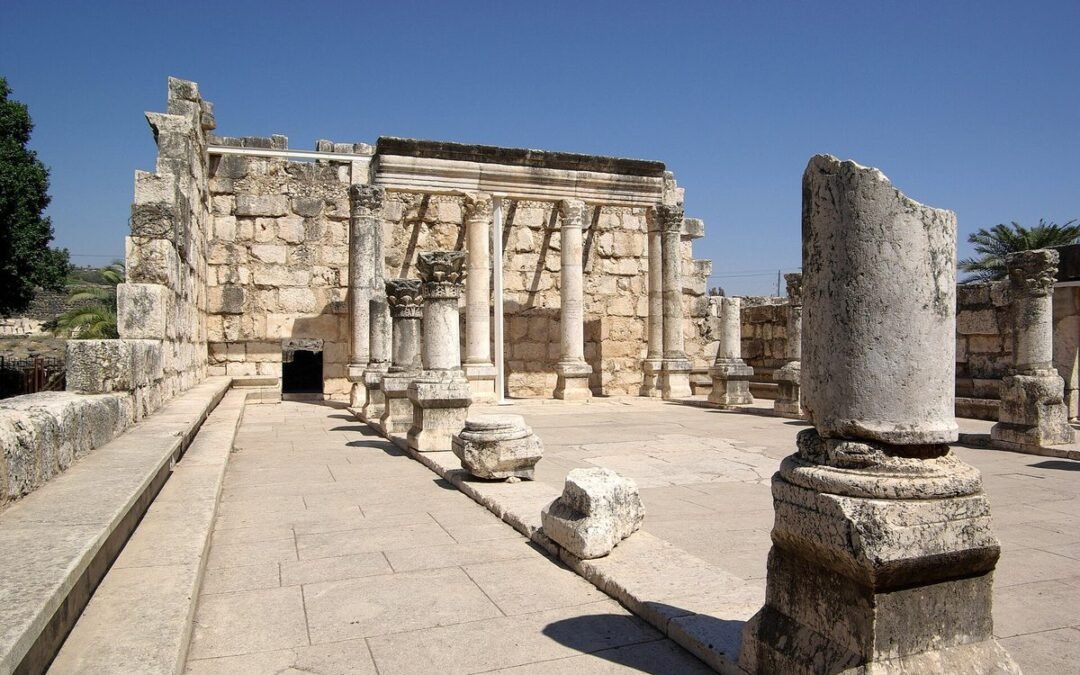
The synagogue you see today is not the one where Jesus taught.7 It was built of white limestone, while the houses were of dark basalt; its blocks weighed up to 4 metric tons (about 8,800 lb) and came from quarries several kilometers away.47 The Custody calls it the most ornate synagogue found so far in Galilee; its prayer hall faces south, toward Jerusalem.3
Its date is disputed. Heinrich Kohl and Carl Watzinger, who dug from 1905, placed the ruins around A.D. 200; Fr. Corbo and Fr. Loffreda, from coins and pottery, in the late 4th century.4 The Custody now assigns the building to the 5th century: the coins beneath its floor show it was finished in the last quarter of that century.3
What lies underneath matters more for the Gospels. Beneath the central nave the Franciscans found a wide 1st-century basalt pavement, so large that it must have belonged to a public building, perhaps the synagogue built by the centurion.34 The foundations are walls of squared basalt blocks, visible on the outside and aligned differently from the limestone building; Fr. Corbo took them for part of the 1st-century building, Fr. Loffreda for an intermediate stage.3
Daily life in a fishing village: houses, boats, customs
Houses were built of basalt stones set in mud, with stone floors. Several families of one clan shared rooms around a courtyard with a bread oven. The roof of beams and leaves covered with pressed mud was used for sleeping on hot nights and for drying nets and fish.3 The paralytic’s friends opened up such a roof (Mk 2:4).9
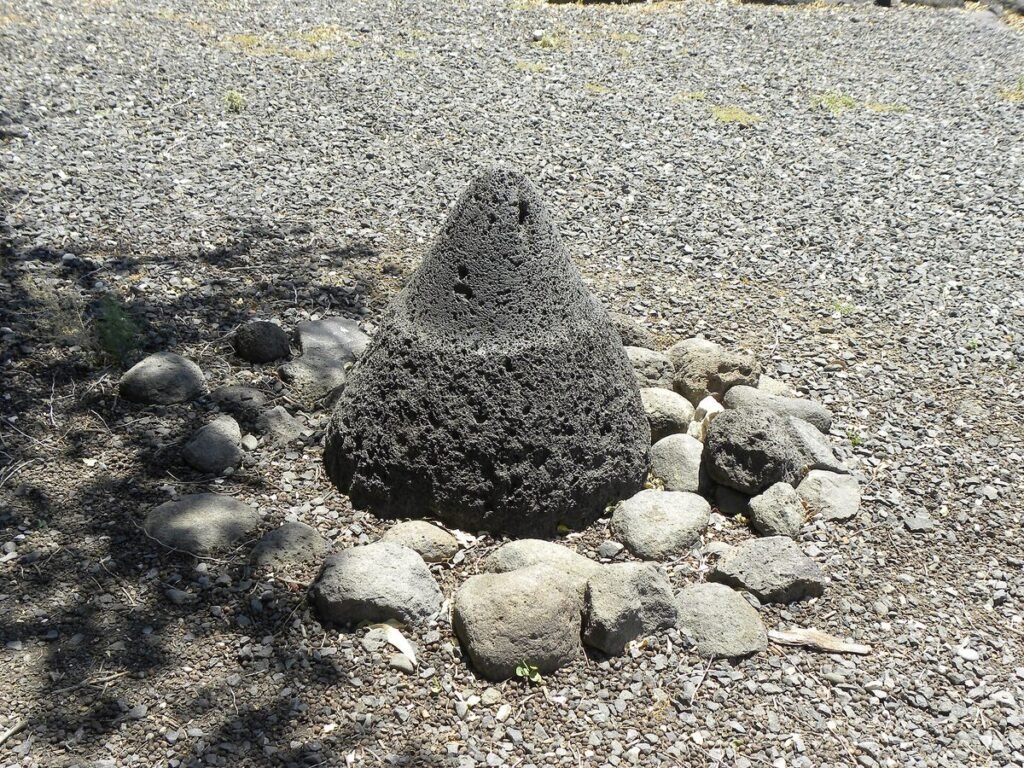
Fishing was among the most profitable trades. Simon and Andrew, James and John were fishermen; the sons of Zebedee ran a small business with their own boats and hired hands. People also farmed and pressed olives and grapes, and traces of the harbor have been found.3 More in Daily life and under Simon Peter.
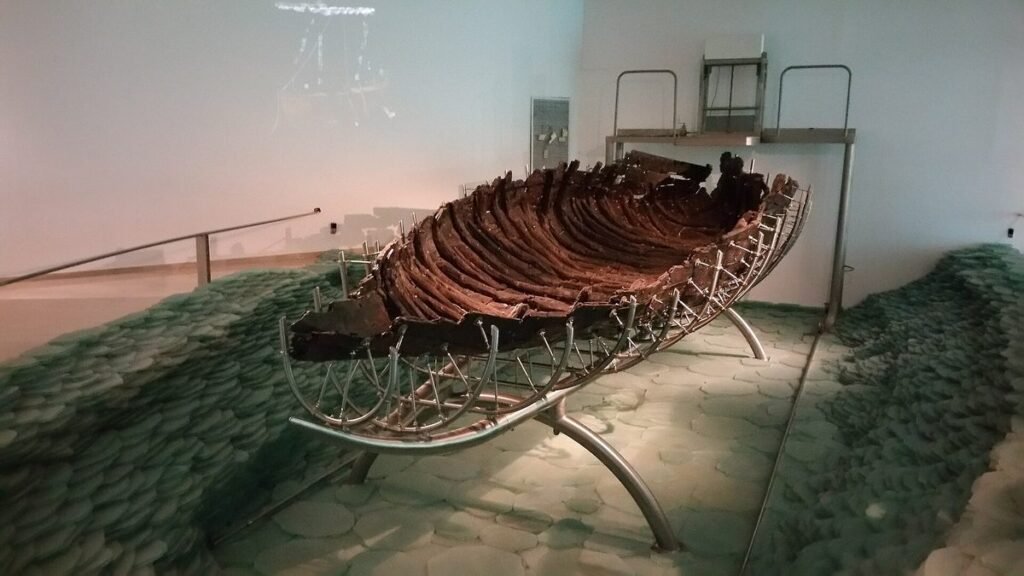
Capernaum lay on a branch of the Via Maris, the trade route from Egypt to Damascus; the Gospels’ customs post and a milestone of Emperor Hadrian (117–138) attest to it.3 The milestone turned up in 1975 about 330 feet (100 m) northwest of the synagogue. About 3 miles (5 km) away, the upper Jordan marked the border between the lands of Herod Antipas and his brother Philip.4 A Roman detachment under a centurion was stationed here, and the annual temple tax was collected here (Mt 17:24).315 At the customs post Jesus called Levi (Mk 2:14); his story is told under Matthew.
Capernaum today
From the 7th century on the village declined.3 Today the friars welcome pilgrims every day. The eastern part of the site belongs to the Greek Orthodox Patriarchate of Jerusalem; there Vassilios Tzaferis excavated from 1978 to 1987 and found a sea wall about 660 feet (200 m) long and a hoard of 282 gold dinars.4
| Year | What happened |
|---|---|
| late 4th or 5th c. | The white synagogue is built; its date is disputed.43 |
| 13th–14th c. | The village is abandoned; the last fishermen leave by the 14th century at the latest.3 |
| 1890–1894 | Br. Giuseppe Baldi acquires the land; after eight years of negotiations, all titles pass to the Custody on September 19, 1894.3 |
| 1964 | Pope St. Paul VI, the first pope since St. Peter to come to the Holy Land, includes Capernaum in his January 4–6 pilgrimage.1617 |
| 1968 | On April 16 the Franciscans resume digging and find Peter’s house.3 |
| 1990 | The memorial church over the house is consecrated on June 29.3 |
| 2000 | St. John Paul II visits Peter’s house and the synagogue on March 24.1819 |
The friars keep three feasts here: the Promise of the Eucharist (third Friday of Easter), St. Peter (June 29) and the Solemnity of Capernaum, the City of Jesus (second Saturday of October).3 St. John Paul II recalled seeing “in Capernaum the remains of Peter’s house and the synagogue where Jesus revealed himself as the Bread come down from heaven.”19 The Franciscans’ finds are shown only in the Custody’s Terra Sancta Museum in Jerusalem; among them is an amount of Roman tableware (terra sigillata) unique in the Holy Land.2021
Bible references and short quotations from the NABRE. Where archaeologists interpret or disagree, we say so; the tradition of the Church is given as the Custody of the Holy Land describes it.
Frequently asked questions
Why is Capernaum called Jesus’ own town?
Because Jesus left Nazareth and went to live in Capernaum by the sea (Mt 4:13). When Matthew says Jesus “came into his own town” (Mt 9:1), the NABRE note explains that this means Capernaum.
Is the synagogue at Capernaum the one where Jesus taught?
No. The white limestone building dates from the late 4th or the 5th century. Beneath it the Franciscans found a basalt pavement from the 1st century, perhaps from the synagogue of Jesus’ time.
How was Peter’s house found?
In 1968 the Franciscans Virgilio Corbo and Stanislao Loffreda dug beneath a 5th-century octagonal church. They found a house whose room was already a Christian meeting place at the end of the 1st century; pilgrims scratched the name of Jesus into its plaster.
What can you see in Capernaum today?
The ruins with the white synagogue and the memorial over Peter’s house, consecrated on June 29, 1990. Two-thirds of the site belong to the Custody of the Holy Land, the eastern part to the Greek Orthodox Patriarchate.
Sources
- New American Bible, Revised Edition, © Confraternity of Christian Doctrine, bible.usccb.org: Gospel according to Matthew, chapter 4 (checked Oct 22, 2026)
- New American Bible, Revised Edition, © Confraternity of Christian Doctrine, bible.usccb.org: Gospel according to Matthew, chapter 9, with the note on 9:1 (checked Oct 22, 2026)
- Custodia Terrae Sanctae (Custody of the Holy Land): Capernaum (shrine: history, archaeology, visit, feasts) (checked Oct 22, 2026)
- Francesco Patton OFM: Following in Jesus’ Footsteps: Capernaum, the Town of Jesus, Vatican News, Aug 7, 2026 (based on S. Loffreda OFM, Cafarnao, Jerusalem 1995) (checked Oct 22, 2026)
- Catechism of the Catholic Church, nos. 1338–1339, vatican.va (checked Oct 22, 2026)
- Siméon Vailhé: Capharnaum, The Catholic Encyclopedia, vol. 3, 1908 (checked Oct 22, 2026)
- Opus Dei: Kafarnaum, die Stadt Jesu (series „Spuren unseres Glaubens“), Jan 18, 2014 (in German) (checked Oct 22, 2026)
- New American Bible, Revised Edition, © Confraternity of Christian Doctrine, bible.usccb.org: Gospel according to Mark, chapter 1 (checked Oct 22, 2026)
- New American Bible, Revised Edition, © Confraternity of Christian Doctrine, bible.usccb.org: Gospel according to Mark, chapter 2 (checked Oct 22, 2026)
- New American Bible, Revised Edition, © Confraternity of Christian Doctrine, bible.usccb.org: Gospel according to Matthew, chapter 8 (checked Oct 22, 2026)
- New American Bible, Revised Edition, © Confraternity of Christian Doctrine, bible.usccb.org: Gospel according to Luke, chapter 7 (checked Oct 22, 2026)
- New American Bible, Revised Edition, © Confraternity of Christian Doctrine, bible.usccb.org: Gospel according to John, chapter 6 (checked Oct 22, 2026)
- New American Bible, Revised Edition, © Confraternity of Christian Doctrine, bible.usccb.org: Gospel according to Matthew, chapter 11 (checked Oct 22, 2026)
- Catechism of the Catholic Church, no. 1386, vatican.va (checked Oct 22, 2026)
- New American Bible, Revised Edition, © Confraternity of Christian Doctrine, bible.usccb.org: Gospel according to Matthew, chapter 17, with the note on 17:24 (checked Oct 22, 2026)
- Vatican Radio: Paul VI in the Holy Land: a sound picture of the first ‘pilgrim pope’, May 25, 2014 (checked Oct 22, 2026)
- Diocese of Trieste: Il pellegrinaggio di Paolo VI in Terra Santa, un evento di portata storica (reprinted from Vatican Insider, Jan 10, 2019), PDF (in Italian) (checked Oct 22, 2026)
- Vatican Information Service (VIS): program for Mar 24, 2000 (Tabgha and Capernaum), via katolsk.no (Catholic Church in Norway) (checked Oct 22, 2026)
- John Paul II: General Audience, Mar 29, 2000 (looking back on the pilgrimage to the Holy Land), vatican.va (checked Oct 22, 2026)
- Terra Sancta Museum (Custody of the Holy Land): The new Saller wing at the Museum of the Flagellation (interview with curator Daniela Massara), Jul 11, 2022 (checked Oct 22, 2026)
- Terra Sancta Museum (Custody of the Holy Land): Visiting the Terra Sancta Museum … the archaeological collections of the Studium Biblicum Franciscanum (Daniela Massara), May 8, 2021 (checked Oct 22, 2026)
Figures and dates from the sources listed; the total of excavation seasons and the conversions to feet, miles, acres and pounds are our own. Found a mistake? Write to hello@biblebehindthescreen.com.