
This article in other languages: Deutsch · Polski
All four Gospels call Mary Magdalene by name.12 She followed Jesus from Galilee to Jerusalem, stood by the cross and on Easter morning was the first to see the risen Lord. Here is what the Gospels say about her, why the Church calls her the “apostle of the apostles,” and what archaeologists have found in her hometown of Magdala.
What the Gospels tell us about her
Luke introduces her: Jesus journeys from one town and village to another with the Twelve and some women who had been cured of evil spirits and infirmities, among them “Mary, called Magdalene, from whom seven demons had gone out” (Lk 8:2). Luke also names Joanna and Susanna, who with many others provided for Jesus and the disciples out of their resources.4 Pope Francis puts it simply: before she met Jesus, she had been at the mercy of evil.9
She appears again in Jerusalem. With other women she watches the crucifixion from a distance (Mt 27:55–56; Mk 15:40–41); John places her with the mother of Jesus by the cross (Jn 19:25); she also sees where Jesus is laid (Mt 27:61; Mk 15:47).1 St. John Paul II wrote that in this most arduous test of faith the women proved stronger than the Apostles; John was the only Apostle who remained faithful.10
The Gospels name her with her hometown twelve times: three times in Matthew, four times in Mark, twice in Luke and three times in John. The NABRE calls her “Mary Magdalene” in the first three Gospels and “Mary of Magdala” in John; in Jn 20:11 and 20:16 she is simply “Mary.”1112
| What happens | Mt | Mk | Lk | Jn |
|---|---|---|---|---|
| In Galilee: freed from seven demons, follows Jesus | 27:55 (women from Galilee) | 15:41 (women from Galilee); 16:9 | 8:1–3 | – |
| At the cross | 27:55–56 | 15:40–41 | 23:49 (women from Galilee, not named) | 19:25 |
| At the burial | 27:61 | 15:47 | 23:55 (not named) | – |
| At the empty tomb | 28:1–8 | 16:1–8 | 24:1–10 | 20:1–2 |
| Meets the risen Lord | 28:9–10 (with the other Mary) | 16:9 | – | 20:11–17 |
| News for the disciples | 28:8 | 16:10 | 24:9–10 | 20:18 |
| Named with her hometown | 3× (27:56; 27:61; 28:1) | 4× (15:40; 15:47; 16:1; 16:9) | 2× (8:2; 24:10) | 3× (19:25; 20:1; 20:18) |
Easter morning: the first witness
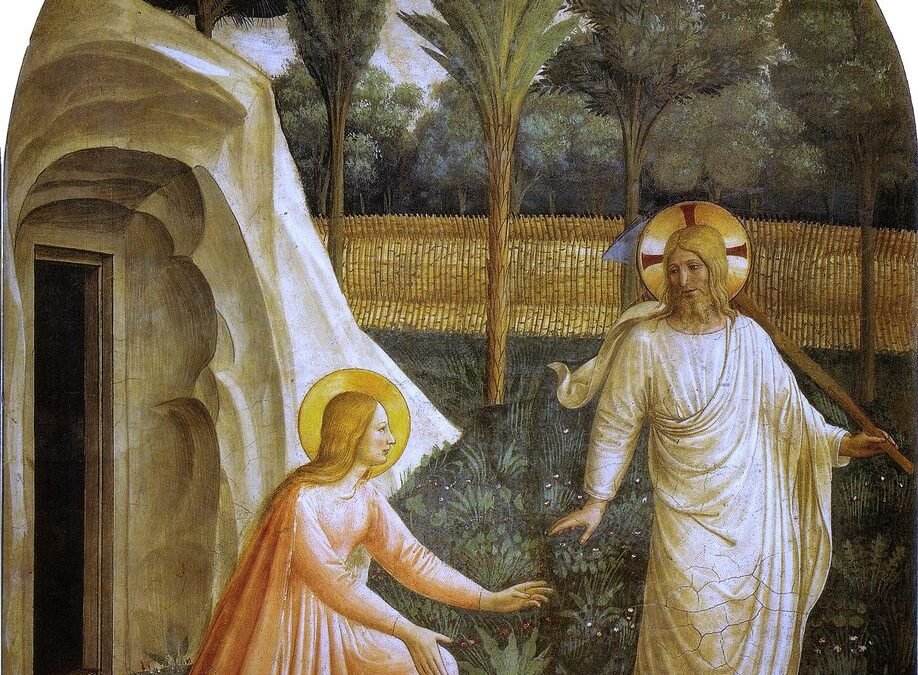
John tells how Mary of Magdala came to the tomb early in the morning, “while it was still dark,” saw the stone removed and ran to Simon Peter and the other disciple (Jn 20:1–2).11
Then she stays at the tomb, weeping. She thinks the risen Lord is the gardener and recognizes him only when he calls her by name: “Mary!” She answers “Rabbouni,” which means Teacher. Jesus sends her to his brothers, and she announces to the disciples: “I have seen the Lord” (Jn 20:11–18).11
Matthew, too, tells how Jesus met her and the other Mary (Mt 28:1, 9–10), and the Longer Ending of Mark says that he appeared first to Mary Magdalene (Mk 16:9).12 This ending (Mk 16:9–20) was defined as canonical by the Council of Trent.13 The Catechism notes that Mary Magdalene and the holy women were the first to encounter the Risen One and so “the first messengers of Christ’s Resurrection for the apostles themselves” (CCC 641).5
“Apostle of the apostles”: the title and the feast
Because she announced to the apostles what they in turn would proclaim to the whole world, Rabanus Maurus and St. Thomas Aquinas called her apostolorum apostola, the apostle of the apostles.7 The German Schott missal traces the title back to St. Hippolytus of Rome in the 3rd century.14 St. John Paul II took it up in 1988: Mary Magdalene was the first eyewitness of the Risen Christ, and so the first to bear witness to him before the Apostles.10
By a decree of June 3, 2016, the Solemnity of the Most Sacred Heart of Jesus, the Congregation for Divine Worship made known the decision of Pope Francis: Saint Mary Magdalene is inscribed in the General Roman Calendar with the rank of a feast rather than a memorial; the day remains July 22.6 Published on June 10, 2016, the decree added a proper preface, de apostolorum apostola.15
Archbishop Arthur Roche, the Congregation’s secretary, explained in an accompanying article that it is right for her celebration to have the same rank as the feasts of the apostles, and recalled Gregory the Great: because a woman offered death to a man in Paradise, a woman announces life to the men from the tomb.7
Honored in East and West
The 2016 decree opens by recalling that the Church, in the East and in the West, has always honored Mary Magdalene with the greatest reverence, although in diverse ways.6 Ecclesial tradition in the West, especially since Gregory the Great, saw in her also the woman who anointed Jesus’ feet with perfume in the house of Simon the Pharisee (Lk 7:36–50) and Mary of Bethany, the sister of Martha and Lazarus. According to Archbishop Roche, this reading shaped Western church writers, Christian art and liturgical texts.7 The Greek Fathers, as a whole, distinguished three women.2
The Bollandists studied the question in detail and prepared the way for the reform of the Roman Calendar, approved by Pope St. Paul VI on February 14, 1969; since then the texts of the Roman Missal, the Liturgy of the Hours and the Martyrology refer to Mary of Magdala.716 What is certain, Roche writes, is that she belonged to Jesus’ disciples, followed him to the foot of the cross and was, in the garden of the tomb, the first “witness of Divine Mercy,” as Gregory the Great called her.76
Magdala: the town of fish
The name “Magdalene” points to Magdala, in Hebrew Migdal, “tower.”17 The town lies on the west shore of the Sea of Galilee, nearly 4 miles (6 km) north of Tiberias, and today is again called Migdal. In Hellenistic and Roman times it was a thriving town known for processing and salting fish, so ancient sources call it Tarichea, from the Greek tarichos, “salted fish.”3 The Talmud speaks of “Magdala of the Fishes.”17
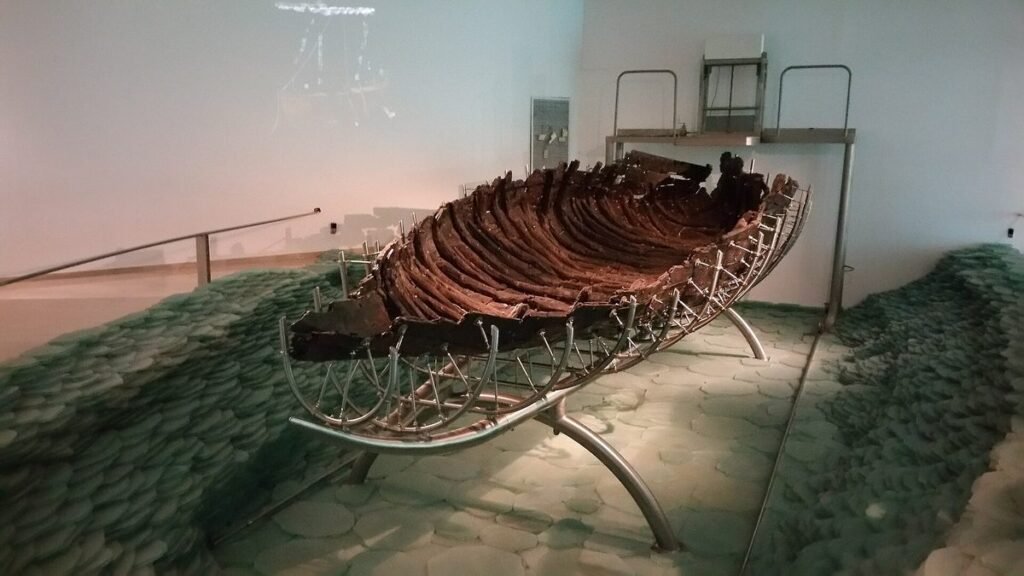
Magdala was destroyed in the First Jewish War (66–70) and never rebuilt.3 Christian tradition honored it as Mary Magdalene’s home: a church in her memory is said to have stood here in the 4th century, and in the 10th century pilgrims were shown her church and house.17 How the fishermen worked is in Fishing on the lake.
What has been found at Magdala since 2009
Fr. Juan Solana of the Legionaries of Christ bought land on the lakeshore in 2004 to build a pilgrim center. When work began in 2009, archaeologists of the Israel Antiquities Authority came upon a first-century town.188 The Custody of the Holy Land calls the synagogue they uncovered one of the oldest in Galilee, with a valuable floor mosaic3; coins found in it date from A.D. 5 to 63.198
The best-known find is the Magdala Stone: a limestone block carved on four sides and on top, including a seven-branched menorah. It stood at the center of the synagogue and may have served as a table for reading the Torah.8 The Custody reads the relief as a symbolic image of the Temple in Jerusalem.3 According to Crux, it is the first such carving of the menorah found in a synagogue built while the Temple was still standing.20 In 2017 the stone left Israel for the first time, for a joint exhibition of the Vatican Museums and the Jewish Museum of Rome.8
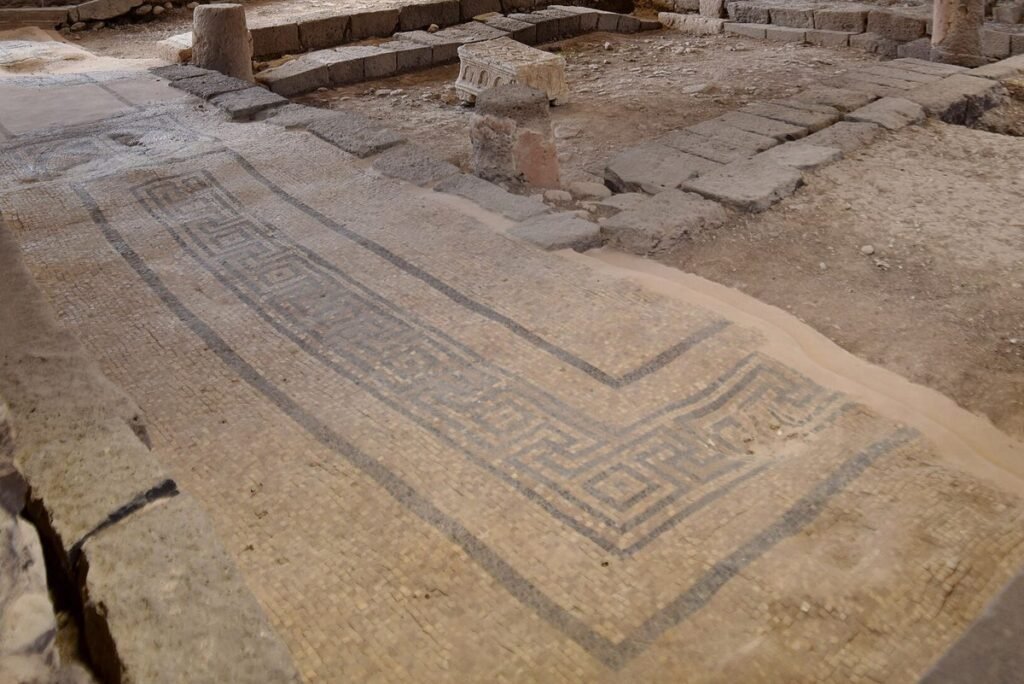
- Around the synagogue: houses, paved streets, warehouses, tanks for processing fish and a harbor3, as well as ritual baths.20
- Market and wharf: a market street lined with shops, a large warehouse beside a stone wharf that now stands on dry ground, and villas with mosaic floors.19
- A second synagogue: found in 2021 less than 650 feet (200 m) away, from the same period; the first time two synagogues have turned up in one Second Temple-era town.20
- The Franciscan dig: the Franciscans excavate their own part of the site; Fr. Stanislao Loffreda, OFM, of the Studium Biblicum Franciscanum worked there.2122
Next to the park stands the Duc in Altum church (“launch into the deep,” Lk 5:4); its atrium honors the women of the Gospel, and its lower chapel rests on the first-century harbor market.23
| Year | What happened |
|---|---|
| 66–70 | Magdala is destroyed in the First Jewish War and never rebuilt.3 |
| 590–604 | Pontificate of St. Gregory the Great, who calls Mary Magdalene a “witness of Divine Mercy.”246 |
| 13th c. | St. Thomas Aquinas (d. 1274) calls her the “apostle of the apostles.”256 |
| 1969 | Pope St. Paul VI approves the new General Roman Calendar on February 14; its liturgical texts refer to Mary of Magdala.167 |
| 2009 | Building a Catholic pilgrim center uncovers a first-century synagogue and the Magdala Stone.83 |
| 2014 | Pope Francis blesses the tabernacle of the Duc in Altum church on May 26.23 |
| 2016 | Decree of June 3: July 22 becomes a feast.615 |
| 2017 | Catechesis on the “Apostle of hope”; the Magdala Stone is shown in Rome, its first time outside Israel.98 |
Our People page sums her up, Magdala is on our map of places, and the episode guide shows where Mary Magdalene appears in The Chosen and which passages lie behind those scenes.
Bible references and short quotations from the New American Bible, Revised Edition. What comes from tradition rather than from the Gospels is marked as such, and archaeologists’ readings as readings.
Frequently asked questions
Where was Mary Magdalene from?
Her surname points to Magdala on the west shore of the Sea of Galilee, nearly 4 miles (6 km) north of Tiberias. The town was known for salting fish and was destroyed in the First Jewish War (66–70).
Why is Mary Magdalene called the apostle of the apostles?
Because she was the first to meet the risen Lord and announced to the disciples, “I have seen the Lord” (Jn 20:18). Rabanus Maurus and St. Thomas Aquinas called her so; the German Schott missal traces the title back to St. Hippolytus of Rome.
Is Mary Magdalene the woman in Luke 7?
Luke does not name the woman who anointed Jesus’ feet in the house of a Pharisee (Lk 7:36–50) and introduces Mary Magdalene in Lk 8:2. Western tradition, especially since Gregory the Great, saw one person in them; since the reform of the Roman Calendar, the liturgical texts refer to Mary of Magdala.
When does the Church celebrate Mary Magdalene?
On July 22. Since a decree of June 3, 2016, the day has the rank of a feast in the General Roman Calendar, like the feasts of the apostles, with its own preface.
Sources
- New American Bible, Revised Edition, © Confraternity of Christian Doctrine: references and names follow this translation (checked Oct 22, 2026)
- Hugh Pope, O.P.: St. Mary Magdalen, The Catholic Encyclopedia, vol. 9, 1910 (checked Oct 22, 2026)
- Custodia Terrae Sanctae (Custody of the Holy Land): Magdala (sanctuary, history, excavations) (checked Oct 22, 2026)
- New American Bible, Revised Edition, © Confraternity of Christian Doctrine, bible.usccb.org: Gospel according to Luke, chapter 8, with the note on 8:1–3 (checked Oct 22, 2026)
- Catechism of the Catholic Church, no. 641, vatican.va (checked Oct 22, 2026)
- Congregation for Divine Worship and the Discipline of the Sacraments: Decree on the celebration of Saint Mary Magdalene, Prot. N. 257/16, June 3, 2016, vatican.va (PDF) (checked Oct 22, 2026)
- Archbishop Arthur Roche, Secretary of the Congregation for Divine Worship and the Discipline of the Sacraments: Apostle of the Apostles, June 2016, vatican.va (PDF) (checked Oct 22, 2026)
- CNA/EWTN News: Menorah exhibit in Rome underlines positive Catholic-Jewish relations, May 18, 2017, in Catholic World Report (checked Oct 22, 2026)
- Pope Francis: General Audience, May 17, 2017 (catechesis on Mary Magdalene), vatican.va (checked Oct 22, 2026)
- St. John Paul II: Apostolic Letter Mulieris dignitatem, August 15, 1988, nos. 15–16, vatican.va (checked Oct 22, 2026)
- New American Bible, Revised Edition, © Confraternity of Christian Doctrine, bible.usccb.org: Gospel according to John, chapter 20 (checked Oct 22, 2026)
- New American Bible, Revised Edition, © Confraternity of Christian Doctrine, bible.usccb.org: Gospel according to Matthew, chapter 28 (checked Oct 22, 2026)
- New American Bible, Revised Edition, © Confraternity of Christian Doctrine, bible.usccb.org: Gospel according to Mark, chapter 16, with the note on 16:9–20 (checked Oct 22, 2026)
- Schott-Messbuch (Beuron Archabbey, German Liturgical Institute): July 22, St. Mary Magdalene, introduction (in German) (checked Oct 22, 2026)
- Holy See Press Office: The liturgical memory of Mary Magdalene becomes a feast, like that of the other apostles, bulletin of June 10, 2016 (with the Latin text of the preface) (checked Oct 22, 2026)
- Pope St. Paul VI: Motu proprio Mysterii paschalis on the liturgical year and the new General Roman Calendar, February 14, 1969, vatican.va (checked Oct 22, 2026)
- August Merk: Magdala, The Catholic Encyclopedia, vol. 9, 1910 (checked Oct 22, 2026)
- Abouna (Catholic Center for Studies and Media, Amman): A stroll in the city of La Maddalena as it was in the time of Jesus, June 12, 2014 (from Vatican Insider) (checked Oct 22, 2026)
- Magdala (New Gate to Peace Foundation, Catholic center run by the Legionaries of Christ): Archeological Park (checked Oct 22, 2026)
- Charles Collins: Synagogue where Mary Magdalene may have worshipped discovered in Israel, Crux, Dec 15, 2021 (checked Oct 22, 2026)
- Fr. Cristobal Vilaroig, L.C.: Magdala, a city to be discovered, Magdala Journal, Aug 20, 2024 (checked Oct 22, 2026)
- Custodia Terrae Sanctae: A heartfelt remembrance ... for the passing of Fr. Stanislao Loffreda, OFM, Aug 10, 2025 (checked Oct 22, 2026)
- Magdala: Duc In Altum (church and chapels) (checked Oct 22, 2026)
- Catholic Encyclopedia: Pope St. Gregory I (“the Great”), vol. 6, 1909 (checked Oct 22, 2026)
- Catholic Encyclopedia: St. Thomas Aquinas, vol. 14, 1912 (checked Oct 22, 2026)
We counted the mentions from the references in the table. Found a mistake? Write to hello@biblebehindthescreen.com.