
According to the archaeologists of the Custody of the Holy Land, Nazareth in the time of Jesus was a small farming village in Galilee: simple houses built against caves in the soft limestone, grain silos, cisterns, presses for oil and wine.1 Nobody knows exactly how many people lived there; Opus Dei speaks of about a hundred.2 This is where Jesus grew up and, as Pope Benedict XVI said in Nazareth, “learned the Hebrew tongue”.3
A village missing from the Old Testament
Nazareth does not appear in the Old Testament. It is missing from the list of the towns of Zebulun (Jos 19:10–15), and the Jewish historian Flavius Josephus does not name it either. The name first appears in the Gospels.1 The NABRE note on Joshua 19 adds that the site of the later city lay within Zebulun’s borders.4 Outside the Bible, the name turns up on an inscription found in 1962 in the synagogue of Caesarea Maritima: it lists a priestly family living in Nazareth and, according to the Custody of the Holy Land, attests the village from the 2nd century.1
Luke calls it a town: the angel Gabriel is sent “to a town of Galilee called Nazareth” (Lk 1:26).5 Saint Jerome linked the Hebrew name with “to flower”, but it can also mean “to keep watch”.1 The Catholic Encyclopedia derives it from the Hebrew neser (“a shoot”; NABRE: “bud”), a word from Isaiah 11:1, where “a bud shall blossom” from the roots of Jesse; the Vulgate renders it flos (“flower”).67
Matthew 2:23 is harder to explain: “He shall be called a Nazorean.” The NABRE note says that Jesus’ residence in Nazareth was firmly established and that Matthew sees it as part of God’s foreannounced plan. The town itself is not mentioned in the Old Testament, and no such prophecy can be found there; Matthew may have seen a connection with words that sound like its name, such as nēser, the “bud” of Isaiah 11:1, or nāzîr, one consecrated to God, as Samson was (Jgs 13:5, 7).89 The Catholic Encyclopedia follows Saint Jerome: because Matthew speaks of “the prophets” in the plural, he means the general prophecy that the Messiah would be despised.10 Nathanael’s question fits: “Can anything good come from Nazareth?” (Jn 1:46).11
How big was Nazareth?
The old village ran north to south across the hill where the Basilica of the Annunciation, the Franciscan friary and the Church of St. Joseph stand today. Its edges to the north, south and west are known from tombs, because the dead were buried outside the village.1 Opus Dei speaks of about a hundred inhabitants, most of them farmers2; Catholic News Service called it “a small village” in 2009.12
Still, Nazareth was not insignificant. It was large enough for its own synagogue (Lk 4:16)131, and an old Jewish tradition names it as a home for priests who went up to Jerusalem by turns to serve in the Temple.7 Josephus, who does not mention Nazareth, counted 204 villages and 15 fortified cities in Galilee.14
| What | Figure | Source |
|---|---|---|
| People in the village in Jesus’ time (estimate) | about a hundred | 2 |
| Area dug by the Franciscans, 1955 | about 300 × 200 ft (90 × 60 m) | 1 |
| Depth of the grain silos | up to 6½ ft (2 m) | 1 |
| Grotto of the Annunciation today | about 18 × 20 ft (5.5 × 6.14 m) | 1 |
| Basilica of the Annunciation | 180 ft (55 m) high, 213 × 89 ft (65 × 27 m) | 1 |
| Mount Precipice (tradition) | about 1,300 ft (397 m) high, 1.2 miles (2 km) southeast | 1 |
| Population of the city of Nazareth, 2024 | 75,704 | 15 |
Living by the cave: houses, silos, presses
The Franciscan excavations show a farming village that was already lived in during Iron Age II (about 900 to 600 B.C.). The houses made use of caves cut into the soft limestone. Above or in front of them stood one or more masonry rooms, perhaps an upper floor as well. People worked, cooked and stored food in the caves, and animals were sometimes kept there too.1
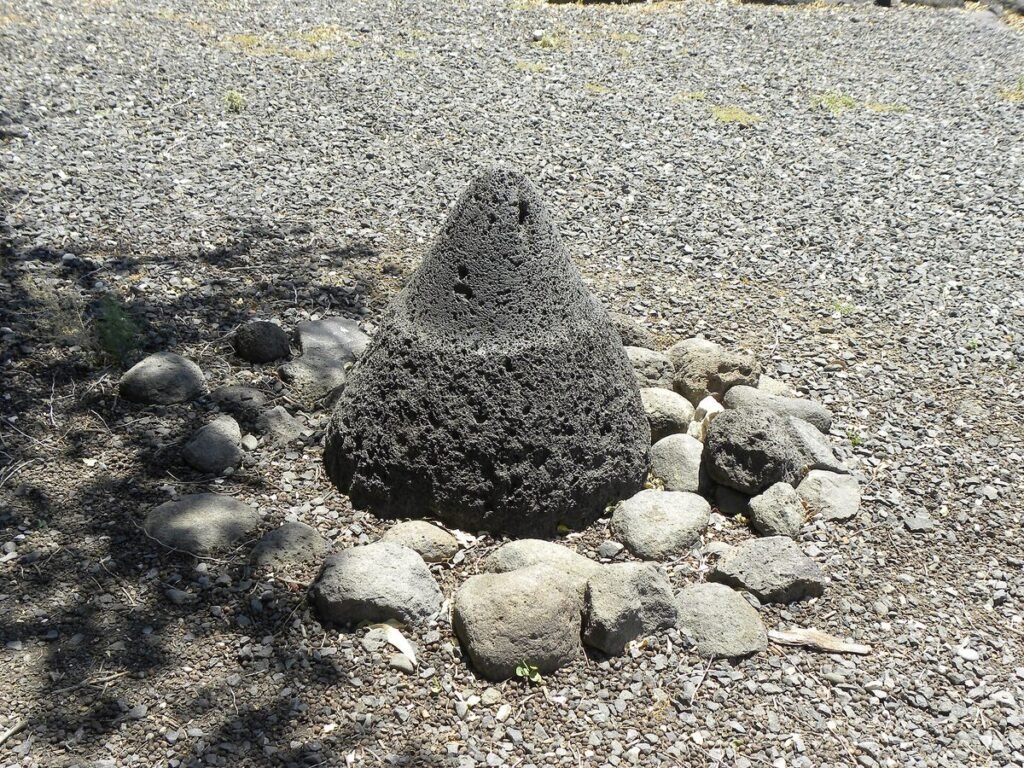
- Grain silos: pear-shaped pits in the rock with a round opening closed by a stone, up to 6½ feet (2 m) deep. They lay on several levels, joined by passages that made storing easier and ventilated the grain.1
- Cisterns collected rainwater.1
- Presses for olives and grapes with cellars for oil and wine, and millstones.116
- At least four homes in the dig: the archaeologist Eugenio Alliata OFM traced how silos and water basins were connected and found at least four separate areas, probably four dwellings. Each had to provide its own water.1
Next to the basilica you can see such a house: a cave with a small room in front of it. Inside the cave are an oven in the northwest corner, silo openings in the floor, handles carved into the rock and a manger, so the cave was at times a stable. To the right and left of the entrance to the Grotto of the Annunciation lie two large grain containers from the time of Jesus and just after; they show that the grotto belonged to the old village.1
Water from the spring
North of the village was a spring, today called Mary’s Well. The Catholic Encyclopedia thinks it was the chief reason people settled here.7 The fountain on the road to Cana was fed by this spring, which rises about 525 feet (160 m) further north; for centuries the women of the town fetched their water there.1
Tombs at the edge of the village
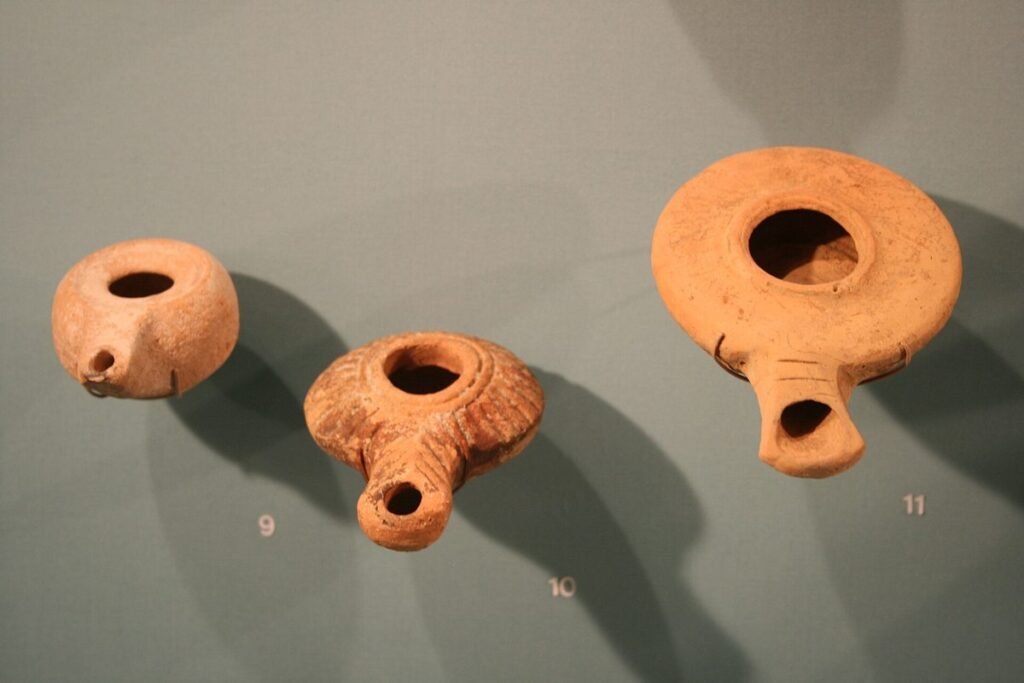
In 1923 a rock-cut tomb of the kokh type with thirteen burial niches was found south of today’s sanctuary. The Roman-period oil lamps and cooking pots in the Custody’s museum come from its grave goods.16 Under the convent of the Sisters of Nazareth lies a tomb with a round rolling stone in front of its entrance, like the tomb the Gospels describe for Jesus (Mk 15:46).117
The house found in 2009
On December 21, 2009, the Israel Antiquities Authority presented the walls of a first-century house, the first of its kind in Nazareth. It was found during building work for the International Marian Center next to the Basilica of the Annunciation. The archaeologist Yardenna Alexandre described it as small and modest, most likely typical of the dwellings in Nazareth at that time: two rooms and a courtyard. She said it was the first house found from the Jewish village of Nazareth.18 In the courtyard was a rock-hewn cistern for rainwater, and most finds were fragments of pottery from the first and second centuries.12 The Custody dates the house to the Herodian period; it resembles the houses from the Franciscan excavations.16
From 2006 the British archaeologist Ken Dark studied a house beneath the convent of the Sisters of Nazareth, partly cut into a limestone hillside. He believes it was a home from the time of Jesus19 and links it with the “Church of the Nutrition”, where in Byzantine times people saw the house in which Jesus grew up.20 The Custody, however, places that church at today’s Church of St. Joseph.1 Dark’s reading is not a settled finding.
What was found beneath the basilica
When the Custody decided in 1954 to build a new basilica over the Grotto of the Annunciation, the old church was pulled down in March 1955. From April to June 1955, more than 120 local workers under Fr. Bellarmino Bagatti OFM and Fr. Gaetano Pierri uncovered an area of about 300 by 200 feet (90 by 60 m) north of the grotto.1 Bagatti published the results in two volumes, in 1967 and 1984.1
- The village itself: in the south the dig found remains of ancient Nazareth, including the house to which the venerated grotto belongs. This shows that the village existed in the time of Jesus.1
- “Hail, Mary”: on the plaster of a column base from a building older than the Byzantine churches, someone scratched ΧΕ ΜΑΡΙΑ. ΧΕ is read as an abbreviation of Χαῖρε, the angel’s greeting in Luke (Lk 1:28: “Hail, favored one!”).215 The Custody’s sources date it differently: before 32422 or before the middle of the 5th century.21
- The deacon Conon: a mosaic at the entrance to a neighboring grotto names a deacon Conon from Jerusalem as donor. He bore the same name as the martyr Conon, who under Emperor Decius (249–251) testified in court that he came from Nazareth and was descended from the family of the Messiah.1
- Unbroken veneration: above the grotto were remains of the first place of prayer. According to the Custody, they show that the memory of this place was kept without a break.1
| Year | What happened |
|---|---|
| c. 383 | The pilgrim Egeria sees a “grand and splendid grotto” with an altar, where the Virgin Mary was said to have lived.1 |
| c. 570 | A pilgrim from Piacenza sees the “house of Mary” turned into a basilica.1 |
| 670 | The pilgrim Arculf finds two churches: one over the house of Mary and the “Church of the Nutrition”, today St. Joseph’s.1 |
| 1730 | The Franciscan Custos blesses a new church over the grotto on October 15.1 |
| 1955 | The old church is pulled down; from April to June more than 120 workers under Fr. Bellarmino Bagatti OFM uncover the site.1 |
| 1959 | Parts of an older place of worship come to light beneath the Byzantine mosaics.1 |
| 1964 | Pope St. Paul VI visits Nazareth on January 5; the new basilica is being built.231 |
| 1969 | Consecration of the new Basilica of the Annunciation in March.1 |
| 2000 | St. John Paul II celebrates Mass in the basilica on March 25.24 |
| 2009 | Benedict XVI celebrates Mass on Mount Precipice on May 14; in December a first-century house is presented.2518 |
Daily life: work, synagogue, the city next door
Joseph was a tekton: the people of Nazareth ask, “Is he not the carpenter’s son?” (Mt 13:55)26, and Jesus himself is called “the carpenter” (Mk 6:3); the NABRE note adds that no other Gospel calls Jesus a carpenter.27 The Greek word means a craftsman in general and a carpenter in particular. St. Justin Martyr already vouches for “carpenter” in the 2nd century, and tradition follows him.28 The Catholic writer Michael Hesemann points out that timber was rare in the Holy Land and a tekton often worked as a house builder.29
The Catechism calls these years “a daily life spent without evident greatness, a life of manual labour”; his religious life was that of “a Jew obedient to the law of God, a life in the community” (CCC 531).30
In the synagogue of Nazareth Jesus read from the prophet Isaiah (Lk 4:16–30). The building shown today in the souk as the “synagogue” is a hall from the Crusader period. The Custody says plainly that it is not the synagogue of the Gospel; the tradition is strong, though, and pilgrims read this passage there.1 The brow of the hill from which the crowd meant “to hurl him down headlong” (Lk 4:29)13 has been placed by tradition since the Middle Ages on a hill about 1,300 feet (397 m) high, some 1.2 miles (2 km) southeast of the town, today called Mount Precipice.125
Close by lay Sepphoris, the capital of Galilee. According to the Custody, Herod Antipas rebuilt it between A.D. 10 and 20, and it cannot be ruled out that men from Nazareth worked on it too.16 Michael Hesemann gives the distance as four miles (about 6 km).29
Nazareth today
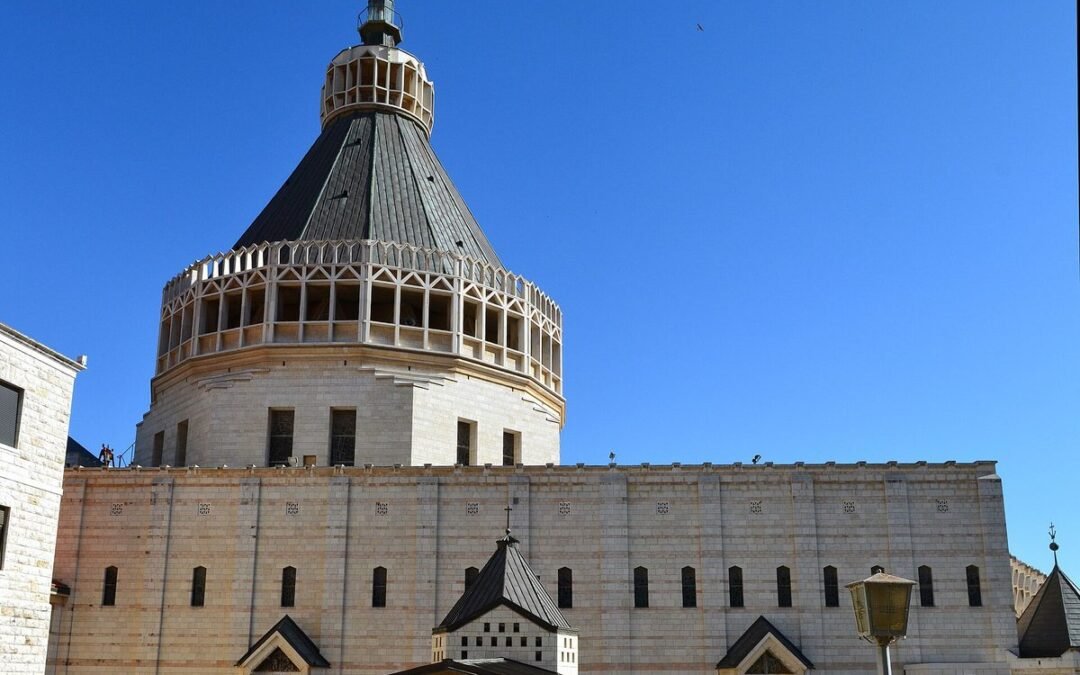
The present Basilica of the Annunciation was designed by the Italian architect Giovanni Muzio and built by masons and stonecutters from Nazareth. It is 180 feet (55 m) high and measures 213 by 89 feet (65 by 27 m). It was consecrated on Sunday, March 23, 1969, after eight years of work, and solemnly opened on the Solemnity of the Annunciation, March 25.1
Pope St. Paul VI came to Nazareth on January 5, 1964, while the basilica was still being built.23 The Catechism quotes his words: “The home of Nazareth is the school where we begin to understand the life of Jesus – the school of the Gospel” (CCC 533).30 St. John Paul II celebrated Mass in the basilica on March 25, 200024, Benedict XVI on Mount Precipice on May 14, 2009.25
Today Nazareth is a city of 75,704 people (2024).15 The Latin parish at the Basilica of the Annunciation has about 5,000 faithful; the city also has Maronite and Melkite communities of the Eastern Catholic Churches.1 More places of the Gospels are on our map of places; how people lived then is in Daily life.
Bible references and short quotations from the New American Bible, Revised Edition. Where archaeologists interpret, we say so; the tradition of the Church is given as the Custody of the Holy Land describes it.
Frequently asked questions
How big was Nazareth in the time of Jesus?
A small farming village, according to the archaeologists of the Custody; Opus Dei speaks of about a hundred people. The Franciscan excavations show cave houses, grain silos, cisterns and presses for oil and wine.
Is Nazareth mentioned in the Old Testament?
No. The NABRE note on Matthew 2:23 says that the town of Nazareth is not mentioned in the Old Testament; it is missing from the list of Zebulun’s towns in Joshua 19.
Where is the Annunciation remembered in Nazareth?
In the Grotto of the Annunciation beneath the Basilica of the Annunciation. The excavations show that the grotto belonged to a dwelling of the ancient village.
Sources
- Custodia Terrae Sanctae (Custody of the Holy Land): Nazareth – Basilica of the Annunciation (history, archaeology, visit) (checked Oct 22, 2026)
- Opus Dei: Bei der Familie von Nazareth (series „Spuren unseres Glaubens“, part 3), Oct 24, 2014 (in German) (checked Oct 22, 2026)
- Benedict XVI: Homily at Vespers in the Upper Basilica of the Annunciation, Nazareth, May 14, 2009, vatican.va (checked Oct 22, 2026)
- New American Bible, Revised Edition, © Confraternity of Christian Doctrine, bible.usccb.org: Book of Joshua, chapter 19, with the note on 19:10–16 (checked Oct 22, 2026)
- New American Bible, Revised Edition, © Confraternity of Christian Doctrine, bible.usccb.org: Gospel according to Luke, chapter 1 (checked Oct 22, 2026)
- New American Bible, Revised Edition, © Confraternity of Christian Doctrine, bible.usccb.org: Book of Isaiah, chapter 11 (checked Oct 22, 2026)
- Barnabas Meistermann OFM: Nazareth, The Catholic Encyclopedia, vol. 10, 1911 (checked Oct 22, 2026)
- New American Bible, Revised Edition, © Confraternity of Christian Doctrine, bible.usccb.org: Gospel according to Matthew, chapter 2, with the note on 2:23 (checked Oct 22, 2026)
- New American Bible, Revised Edition, © Confraternity of Christian Doctrine, bible.usccb.org: Book of Judges, chapter 13 (checked Oct 22, 2026)
- James F. Driscoll: Nazarene, The Catholic Encyclopedia, vol. 10, 1911 (checked Oct 22, 2026)
- New American Bible, Revised Edition, © Confraternity of Christian Doctrine, bible.usccb.org: Gospel according to John, chapter 1 (checked Oct 22, 2026)
- Catholic Review (Archdiocese of Baltimore, from Catholic News Service): Bishop says Nazareth Christians joyful about find of Jesus-era house, Dec 2009 (checked Oct 22, 2026)
- New American Bible, Revised Edition, © Confraternity of Christian Doctrine, bible.usccb.org: Gospel according to Luke, chapter 4 (checked Oct 22, 2026)
- A. McMahon: Galilee, The Catholic Encyclopedia, vol. 6, 1909 (checked Oct 22, 2026)
- Central Bureau of Statistics, Israel (CBS): localities file 2024 (bycode2024.xlsx), Nazareth, code 7300 (checked Oct 22, 2026)
- Custodia Terrae Sanctae: Nazaret – Basilica dell’Annunciazione (Italian version, more detailed) (checked Oct 22, 2026)
- New American Bible, Revised Edition, © Confraternity of Christian Doctrine, bible.usccb.org: Gospel according to Mark, chapter 15 (checked Oct 22, 2026)
- Vatican Radio: Jesus-era house unearthed in Nazareth, Dec 22, 2009 (checked Oct 22, 2026)
- John Burger: British archaeologist confident he has found Jesus’ childhood home, Aleteia, Nov 25, 2020 (checked Oct 22, 2026)
- Archaeologist may have found Jesus’ childhood home in Nazareth, Herald Malaysia (Catholic weekly), Mar 12, 2015 (checked Oct 22, 2026)
- Fabio Beltotto: Χαίρε, Μαρία. Ave Maria. The origins of the Marian cult, Terra Sancta Museum of the Custody, Mar 24, 2020 (checked Oct 22, 2026)
- Custodia Terrae Sanctae: The Terra Sancta Museum of Nazareth, Feb 20, 2020 (checked Oct 22, 2026)
- Paul VI: Visite à la Basilique de l’Annonciation à Nazareth, Jan 5, 1964, vatican.va (French original) (checked Oct 22, 2026)
- John Paul II: Homily in the Basilica of the Annunciation, Nazareth, Mar 25, 2000, vatican.va (checked Oct 22, 2026)
- Benedict XVI: Homily at Mass on Mount Precipice, Nazareth, May 14, 2009, vatican.va (checked Oct 22, 2026)
- New American Bible, Revised Edition, © Confraternity of Christian Doctrine, bible.usccb.org: Gospel according to Matthew, chapter 13 (checked Oct 22, 2026)
- New American Bible, Revised Edition, © Confraternity of Christian Doctrine, bible.usccb.org: Gospel according to Mark, chapter 6, with the note on 6:3 (checked Oct 22, 2026)
- Charles Souvay: St. Joseph, The Catholic Encyclopedia, vol. 8, 1910 (checked Oct 22, 2026)
- K. V. Turley: A Look at ‘The Fifth Gospel’ (interview with Michael Hesemann), National Catholic Register, Apr 1, 2021 (checked Oct 22, 2026)
- Catechism of the Catholic Church, nos. 531 and 533, vatican.va (checked Oct 22, 2026)
Found a mistake? Write to hello@biblebehindthescreen.com.