
This article in other languages: Deutsch · Polski
Matthew is the apostle from the tax booth: Jesus sees him “sitting at the customs post” and says, “Follow me” (Mt 9:9).1 Tax collectors were counted among sinners by many of their countrymen, yet Jesus took one of them into the Twelve. Who were these men, why were they disliked, and what does Church tradition tell us about Matthew?
Who were the tax collectors?
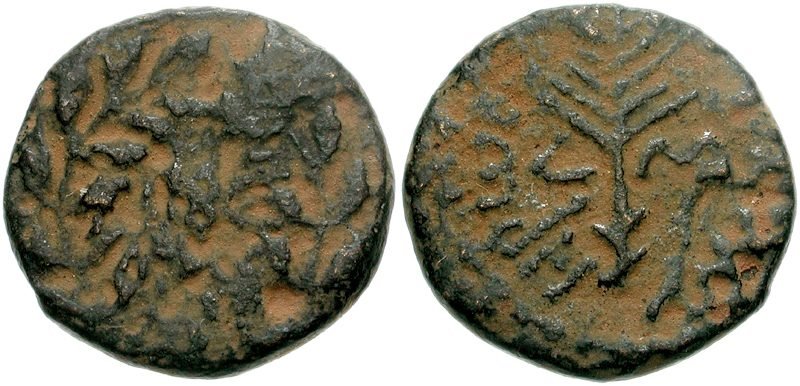
In the Latin Vulgate a tax collector is a publicanus, hence “publican”: according to the Catholic Encyclopedia, a member or employee of the Roman companies that farmed the taxes. The state auctioned off a province’s taxes for a lump sum, and the highest bidder won the right to collect them.7 The tax collectors of the Gospels were Jews who collected indirect taxes such as tolls and customs.4
The NABRE note on Mark 2:14 describes how it worked: a collector paid a fixed sum for the right to collect customs in his district, and whatever he took in above that was his profit, so extortion was widespread.5 John the Baptist tells the tax collectors who come for baptism, “Stop collecting more than what is prescribed” (Lk 3:13).8
Customs in the Galilee of Herod Antipas
In Jesus’ time Herod Antipas, a son of Herod the Great, ruled Galilee as tetrarch (Lk 3:1) until he was banished in A.D. 39.9 The Catholic Encyclopedia says Matthew collected customs at Capernaum for Antipas3, EWTN News that he worked for the Romans10, and Benedict XVI speaks of a foreign authority that could set tributes arbitrarily.2 On toll rates we found no data in the Catholic sources we checked. Benedict XVI places Matthew’s post at Capernaum because Jesus heals a paralytic there just before (Mt 9:1–8).2
Why tax collectors were disliked
Catholic sources give several reasons that came together:
- Profit at others’ expense: whatever a collector took in above the fixed sum was his, and many took advantage of that.5
- Serving foreigners: Jews who served the foreign rulers this way were “objects of execration to their countrymen.”7 Benedict XVI adds that Matthew handled money deemed impure because it came from people outside the People of God.2
- Ritual impurity: sharing a table with them caused ritual impurity (NABRE note on Mt 9:10).1
- Outcasts, with their families: Jewish customs officials were regarded as sinners and outcasts, and their families shared the disgrace.5
That is why the Gospels so often speak of “tax collectors and sinners” in one breath.2 The main passages:
| Passage | What it says about tax collectors |
|---|---|
| Lk 3:12–13 | Tax collectors come to John to be baptized; he tells them, “Stop collecting more than what is prescribed.”8 |
| Mt 5:46 | Loving only those who love you is no more than tax collectors do.4 |
| Mt 9:9–13; Mk 2:13–17; Lk 5:27–32 | The call of Matthew (Levi) and the meal with tax collectors and sinners.1 |
| Mt 11:19; Lk 7:34 | Critics call Jesus “a friend of tax collectors and sinners.”1112 |
| Mt 21:31–32 | Tax collectors and prostitutes believed John and are entering the kingdom of God first.132 |
| Lk 15:1–2 | Tax collectors and sinners draw near to listen; Pharisees and scribes complain. The parables of the lost sheep, the lost coin and the lost son follow.14 |
| Lk 18:9–14 | The parable of the Pharisee and the tax collector in the temple area.15 |
| Lk 19:1–10 | Zacchaeus, a chief tax collector in Jericho, welcomes Jesus into his house.16 |
The call: Matthew or Levi?
The first three Gospels tell the call in almost the same words. Jesus sees a man sitting at the customs post and says, “Follow me.” The man gets up and follows him.1 Luke adds that he left everything behind (Lk 5:28).17 Only the name differs: in Matthew the tax collector is Matthew, in Mark and Luke he is Levi, “son of Alphaeus” in Mark (Mk 2:14).5
The Church sees Levi and Matthew as the same man; Benedict XVI points to Matthew 10:3, which labels Matthew “the tax collector.”2 Two names for one man were common, as with Simon Cephas, and the Catholic Encyclopedia thinks Jesus probably gave the tax collector the name Matthew when he called him.3 The name means “gift of God.”2 The NABRE note on Matthew 9:9 observes that Levi appears in none of the four lists of the Twelve, while all four list a Matthew.1
| Passage | Name | Context | Place in the list |
|---|---|---|---|
| Mt 9:9 | Matthew | call at the customs post1 | – |
| Mk 2:14 | Levi, son of Alphaeus | call at the customs post5 | – |
| Lk 5:27 | Levi | call of “a tax collector named Levi”17 | – |
| Lk 5:29 | Levi | gives a great banquet in his house17 | – |
| Mt 10:3 | “Matthew the tax collector” | list of the twelve apostles18 | 8th of 123 |
| Mk 3:18 | Matthew | list of the Twelve19 | 7th of 12 |
| Lk 6:15 | Matthew | list of the Twelve20 | 7th of 12 |
| Acts 1:13 | Matthew | the Eleven in the upper room in Jerusalem21 | 8th of 11 |
So the name Matthew occurs five times in the New Testament, and the name Levi, for the tax collector, three times. Benedict XVI reads in the short sentence “he got up and followed him” how readily Matthew left a reliable source of income.2
The meal with tax collectors and sinners
In Luke, Levi gives a great banquet for Jesus in his house, with a large crowd of tax collectors and others at table (Lk 5:29)17; in Matthew, the NABRE note says, it is unclear whose house it is.1 Pharisees, in Mark “some scribes who were Pharisees,” ask the disciples why their teacher eats with tax collectors and sinners (Mt 9:11; Mk 2:16).15
Jesus answers with an image from medicine: “Those who are well do not need a physician, but the sick do.” Matthew adds the words of the prophet Hosea: “I desire mercy, not sacrifice” (Mt 9:12–13; Hos 6:6).1 The Catechism says that Jesus “invites sinners to the table of the kingdom” (CCC 545)22 and that eating with them “as familiarly as with themselves” scandalized the Pharisees (CCC 588).23
For Benedict XVI this is the heart of it: Jesus excludes no one from his friendship, and in the parable of the Pharisee and the tax collector (Lk 18:9–14) an anonymous tax collector even becomes the model.2
Zacchaeus, the other tax collector with a name
Only Luke tells of Zacchaeus, “a chief tax collector and also a wealthy man” in Jericho (Lk 19:2).162 Short in stature, he climbs a sycamore tree; Jesus stays at his house, and Zacchaeus promises to give half his possessions to the poor and repay four times over anything he has extorted (Lk 19:1–10).16 More in People.
Apostle and evangelist
After the call, the Gospels mention Matthew only in the lists of the apostles.3 The ancient Church agreed in attributing the first Gospel to him. Papias, Bishop of Hierapolis about the year 130, writes that Matthew set down the words of the Lord in Hebrew; the historian Eusebius adds that Matthew first preached among the Jews and, before going to other peoples, wrote down his Gospel in his mother tongue.2
Of his later life we have only inaccurate or legendary data, says the Catholic Encyclopedia. Ancient writers name Ethiopia (meaning a land south of the Caspian Sea), Persia, Parthia, Macedonia and Syria, and the place and manner of his death are disputed; the Roman Martyrology says he suffered martyrdom while preaching in Ethiopia.3 The Church honors him as a martyr, and red is worn on his feast.24
Feast, symbol and tomb
The Latin Church celebrates the feast of St. Matthew on September 21, the Greek Church on November 16.3 The Gospel at Mass is the call of Matthew (Mt 9:9–13).25 In the Liturgy of the Hours the Church reads a homily of St. Bede that day: Jesus saw the tax collector “by having mercy and by choosing,” miserando atque eligendo. Pope Francis took these words as his motto; on the feast of St. Matthew in 1953, at 17, he had felt God’s call.26
His symbol among the four evangelists is a man, often winged; the symbols go back to the living creatures of Ezekiel 1 and Revelation 4, as St. Jerome explains.327
His remains turned up at Paestum in the 10th century, says the Diocese of Augsburg, and were brought to the Cathedral of San Matteo in Salerno, consecrated in 108528; Aleteia says the 10th or 11th century.24 Archbishop Alfanus I placed the body in the crypt in 1081.10 In Salerno in 1985, St. John Paul II spoke of the cathedral where the apostle’s body is kept with honor.6 Matthew is the patron of Salerno and of customs officers, bookkeepers, bankers and finance workers.28
Caravaggio’s Calling of St. Matthew
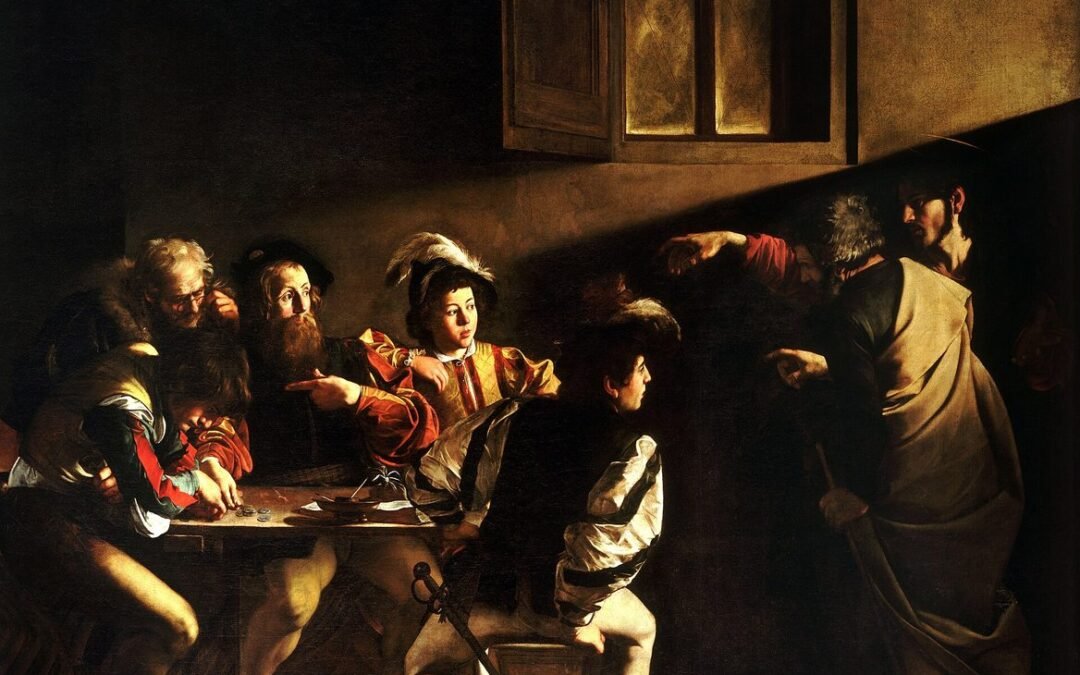
To picture the scene of Matthew 9:9, said Benedict XVI, it suffices to recall Caravaggio’s canvas in San Luigi dei Francesi in Rome (the painting at the top of this page).2 It hangs in the Contarelli Chapel, named after the French cardinal Mathieu Cointrel (Contarelli), who died in 1585 and is buried there; because he bore the name Matthew, the chapel tells the story of his patron saint.29
Caravaggio painted three canvases for the chapel.30 According to the church, he was commissioned to paint the Calling and the Martyrdom in 1600; according to Andrea Lonardo of the Diocese of Rome, both were installed for the Holy Year 1600, and the altarpiece, St. Matthew and the Angel, in 1602.3029
Christ stretches out his arm with the gesture of Adam in Michelangelo’s Creation of Adam.2930 Above his hand, the window frame forms a cross. The men at the table wear clothes of Caravaggio’s day, Christ and Peter the dress of their own time, and both are barefoot. One man keeps a hand on the coins and hesitantly points to himself; the church’s own guide says this hesitation makes one doubt that he is really Matthew.30 Pope Francis recalled in 2013 how often he went to contemplate the painting: “That finger of Jesus, pointing at Matthew. That’s me.”31
Timeline: Matthew in tradition and art
| Year | What happened |
|---|---|
| c. 130 | Papias, Bishop of Hierapolis, attests that Matthew set down the words of the Lord in Hebrew.2 |
| 10th c. | The apostle’s remains turn up at Paestum and are brought to Salerno.28 |
| 1081 | Archbishop Alfanus I completes the crypt of Salerno Cathedral and places Matthew’s body there.10 |
| 1085 | Consecration of the Cathedral of San Matteo in Salerno.28 |
| 1600 | Caravaggio’s Calling and Martyrdom of St. Matthew in the Contarelli Chapel.3029 |
| 1606 | Michelangelo Naccherino’s bronze statue of the Evangelist above the crypt altar in Salerno.10 |
| 1953 | On the feast of St. Matthew, 17-year-old Jorge Mario Bergoglio senses his vocation.26 |
| 1985 | St. John Paul II visits Salerno on May 26.6 |
| 2006 | Benedict XVI devotes his catechesis of August 30 to Matthew.2 |
| 2013 | Pope Francis tells in an interview how often he went to see Caravaggio’s painting.31 |
See also the apostle’s profile in People, the term tax collector in our glossary, and our episode guide for the episodes of The Chosen in which Matthew appears and the Bible passages behind them.
Bible references and short quotations from the New American Bible, Revised Edition. Where sources differ, we give both.
Frequently asked questions
Were Matthew and Levi the same person?
According to the tradition of the Church, yes. Mark and Luke call the tax collector whom Jesus calls Levi; Matthew’s Gospel calls him Matthew and, in the list of the Twelve, “the tax collector” (Mt 10:3).
Why were tax collectors so disliked in Jesus’ time?
They paid a fixed sum for the right to collect customs and kept whatever they took in above it, so extortion was widespread. They also served foreign rulers, and sharing a table with them caused ritual impurity.
When is the feast of St. Matthew?
The Latin Church celebrates it on September 21, the Greek Church on November 16.
Where is St. Matthew buried?
His relics are venerated in the crypt of the Cathedral of San Matteo in Salerno, in southern Italy.
Sources
- New American Bible, Revised Edition, © Confraternity of Christian Doctrine, bible.usccb.org: Gospel according to Matthew, chapter 9, with the notes on 9:9, 9:10 and 9:13 (checked Oct 22, 2026)
- Benedict XVI: General Audience, August 30, 2006 (Matthew, the tax collector), vatican.va (checked Oct 22, 2026)
- Jacques Eugène Jacquier: St. Matthew, The Catholic Encyclopedia, vol. 10, 1911 (checked Oct 22, 2026)
- New American Bible, Revised Edition, © Confraternity of Christian Doctrine, bible.usccb.org: Gospel according to Matthew, chapter 5, with the note on 5:46 (checked Oct 22, 2026)
- New American Bible, Revised Edition, © Confraternity of Christian Doctrine, bible.usccb.org: Gospel according to Mark, chapter 2, with the note on 2:14 (checked Oct 22, 2026)
- John Paul II: Saluto alla città e all’arcidiocesi di Salerno, May 26, 1985, vatican.va (in Italian) (checked Oct 22, 2026)
- James F. Driscoll: Publican, The Catholic Encyclopedia, vol. 12, 1911 (checked Oct 22, 2026)
- New American Bible, Revised Edition, © Confraternity of Christian Doctrine, bible.usccb.org: Gospel according to Luke, chapter 3 (checked Oct 22, 2026)
- John Tierney: Herod (section on Antipas), The Catholic Encyclopedia, vol. 7, 1910 (checked Oct 22, 2026)
- Jonah McKeown: Where is the body of St. Matthew? A visit to his tomb, EWTN News, Sep 21, 2026, via Catholic World Report (checked Oct 22, 2026)
- New American Bible, Revised Edition, © Confraternity of Christian Doctrine, bible.usccb.org: Gospel according to Matthew, chapter 11 (checked Oct 22, 2026)
- New American Bible, Revised Edition, © Confraternity of Christian Doctrine, bible.usccb.org: Gospel according to Luke, chapter 7 (checked Oct 22, 2026)
- New American Bible, Revised Edition, © Confraternity of Christian Doctrine, bible.usccb.org: Gospel according to Matthew, chapter 21 (checked Oct 22, 2026)
- New American Bible, Revised Edition, © Confraternity of Christian Doctrine, bible.usccb.org: Gospel according to Luke, chapter 15 (checked Oct 22, 2026)
- New American Bible, Revised Edition, © Confraternity of Christian Doctrine, bible.usccb.org: Gospel according to Luke, chapter 18 (checked Oct 22, 2026)
- New American Bible, Revised Edition, © Confraternity of Christian Doctrine, bible.usccb.org: Gospel according to Luke, chapter 19, with the note on 19:1–10 (checked Oct 22, 2026)
- New American Bible, Revised Edition, © Confraternity of Christian Doctrine, bible.usccb.org: Gospel according to Luke, chapter 5 (checked Oct 22, 2026)
- New American Bible, Revised Edition, © Confraternity of Christian Doctrine, bible.usccb.org: Gospel according to Matthew, chapter 10 (checked Oct 22, 2026)
- New American Bible, Revised Edition, © Confraternity of Christian Doctrine, bible.usccb.org: Gospel according to Mark, chapter 3 (checked Oct 22, 2026)
- New American Bible, Revised Edition, © Confraternity of Christian Doctrine, bible.usccb.org: Gospel according to Luke, chapter 6 (checked Oct 22, 2026)
- New American Bible, Revised Edition, © Confraternity of Christian Doctrine, bible.usccb.org: Acts of the Apostles, chapter 1 (checked Oct 22, 2026)
- Catechism of the Catholic Church, no. 545, vatican.va (checked Oct 22, 2026)
- Catechism of the Catholic Church, no. 588, vatican.va (checked Oct 22, 2026)
- Philip Kosloski: How did St. Matthew the Apostle die?, Aleteia, Sep 21, 2022 (checked Oct 22, 2026)
- USCCB, Daily Readings: Feast of Saint Matthew, Apostle and evangelist, September 21, 2026 (Lectionary 643) (checked Oct 22, 2026)
- The Coat of Arms of Pope Francis: miserando atque eligendo, vatican.va (checked Oct 22, 2026)
- Charles Souvay: Evangelist, The Catholic Encyclopedia, vol. 5, 1909 (checked Oct 22, 2026)
- Diocese of Augsburg, Saint of the Day: Matthäus (in German) (checked Oct 22, 2026)
- Andrea Lonardo: Le storie di San Matteo nella Cappella Contarelli. Contemplare la misericordia con Caravaggio, lecture in the Letture teologiche of the Diocese of Rome, Lateran Palace, Jan 21, 2016 (in Italian) (checked Oct 22, 2026)
- Saint-Louis-des-Français, Rome (the French national church): Les Caravages (in French) (checked Oct 22, 2026)
- Interview with Pope Francis by Fr. Antonio Spadaro, S.J. (La Civiltà Cattolica), L’Osservatore Romano, Sep 21, 2013, vatican.va (checked Oct 22, 2026)
We counted the mentions and list places from the Bible passages themselves. Found a mistake? Write to hello@biblebehindthescreen.com.